• Meet the family

  • Enter Slide 2 Title Here

  • Enter Slide 3 Title Here

Saturday, August 2, 2014

My get ready for Australian power / Will my TV, computer, device or appliance work in Australia?? guide

Australian power is 230 Volts and 50 Hz.  A medium sized plug is used that looks like you took a three prong US / Canadian plug and bent two of the flat blades of the plug out...as per below.  The wall plugs are also always switched like you see in England.


This is not a voltage change if you are coming from most of the world with 220-240Volt power. In that case you either use a plug adapter (see a paragraph below) or cut the plugs off and buy a rewireable Australian plug at your local Bunnings, Masters or electrical wholesaler. Wire it up (or hire an electrician to do it) and you're good to go.

Rewireable plugs are easy to buy at Bunnings, Masters or many other shops


North American electrical items are a bigger problem.  Our kitchen appliances, stereo receivers and most TV's (more on TV's later) are 120 V - 60 Hz.  Unless you plan to plug in a big step down transformer rated to handle the power requirement they're not going to work in Australia.  For this reason, we have a whole pile of really nice small kitchen appliances sitting in a big wooden box in Canada.  I regret not bringing our stereo receiver and speakers as they're pretty expensive here but otherwise that seems like it was a good decision. I also don't like the idea of big step down transformers sitting around the house.

A relatively small step down transformer with US / Canada / European outputs.


Computer / tech gear is a different scenario.  Most computers*, laptops, monitors, cellular/mobile phones and other computer peripherals in general have auto switching / universal power packs.  My electric razor was also fine.  You can tell by looking at the power pack which should say something like 100-240V AC 50/60Hz.  If you see this range you are good to go and just need the plug adapter.  We did have a couple of computer items that were a problem including the printer and pc speakers but everything else was fine.  One small technicality to note is that electrical items "should" have the Australian "check mark" as shown below in order to be used here.  I have found that most electronic gear has it, but some may not.

*Be a little careful with desktop computers which may require you flick a switch to enter 230V mode.


Quickly on Australian plug adapters....we originally bought a 10 pack of US/Canada to Australian plug adapters on eBay.  While these have filled a gap, the quality is really suspect (honestly, they're terrible!) and some of them either don't stay plugged in or don't hold the plug you are trying to adapt.  They will move electrons across but consider yourself warned.  The more expensive ones such as Korjo (readily available at airports and Dick Smiths) definitely work a LOT better.

I love the "High Quality" comment.  Buyer beware on these eBay Australian plug adapters.
These adapters from Korjo are readily available and work excellent at a price.

The even better solution has been (where possible) buying the correct IEC power cords (some people call these kettle leads or cords).  I always knew that computers seemed to use the same style of cables but I didn't realize that they were part of global standards, easily available with any countries plug end and relatively inexpensive.  As per the chart below which I shortened to focus only on some of the more common cords, the ones you likely have are the C5-which is usually your laptop, the C7-this was on one of my scanners and apparently is used for for some appliances and the most common C13-which is used on TV's, monitors, printers, desktop computers and more.  For some reason when you buy the cables they refer to the female end even though you're buying the male end.


I did a quick survey of all of my tech gear and found that I was easily able to create a shopping list of all of the cables I needed.  I used website www.4cabling.com.au  which has all of the cables with Australian plug ends for approx $5.00 per piece and ridiculously good service.  The cables themselves are perfect.  For the 10 dollar shipping fee I had my plugs in Perth the next day.  There were a number of options with the cheapest being eBay but I decided I didn't want to chance it on these.

An example of an IEC power cord for my PC.


The result is we're down to just 3 US / Canada plugs-my electric shaver which will cost almost as much to buy a new plug as a new razor (note to self, buy a new razor, you never get a decent shave anymore), a Bose stereo plug which has an interchangeable plug but I can't find them, and one iPad charger which could easily be replaced from the Apple monsters.  Don't ask me why, but these projects make me smile.  (Note to self, get help)

** Exceptions you need to know about:

Wireless home phones (not cellular / mobile phones) from the US / Canada cannot be used here as they use a different frequency which is causes a conflict in Australia.  I never tried and don't suggest it.  See my post on my awesome voip phone for what I use here.

Television broadcasts have different standards in different parts of the world.  That said will always work as monitors from computers or same standard DVD players (assuming they have universal power or you buy a large enough step down transformer) but US/Canadian TV's will very likely not be able to play broadcast television.   We ended up leaving 2 big plasma TV's in that big wooden box.  For other countries see below the current digital standards around the world.


Some helpful links:

Want to know what power your country or any country has... http://en.wikipedia.org/wiki/Mains_electricity_by_country

More on IEC standard cables.... http://en.wikipedia.org/wiki/IEC_60320

A good discussion on bringing a US / Canadian TV to Australia (the summary-don't bother) http://www.avsforum.com/forum/25-hdtv-technical/1390270-possible-bring-us-cdn-tv-australia-atsc-dvb-t.html

About the digital television standard DVB-T that Australia uses: DVB-T and Countries using it

Sunday, July 20, 2014

Kalbarri is worth a trip

We did this trip up to Kalbarri in early January.  It is about 5-6 hours straight north of Perth on the coast of the Indian Ocean.  The trip was a 5 day, very necessary stress reliever during the events that lead to the bleepedy bleep post here


I think during my time in Australia, this trip stands out as my favorite.  Margaret River will continue to get awards for it's trendy wine country, sea side surf, fancy cave, lots to do, tourist possibilities which may or may not be deserved.  Mostly this depends on perspective but I can see what they love down there.  

That said, I couldn't help but love the Kalbarri Region.  Hope you enjoy...
   
On the way up we started off back at the Pinnacles.  See my original post on the Pinnacles here.  This visit solidified a couple of things.  1 - You should visit the Pinnacles during sun up or sunset as the lighting gives them a totally different feel which can't be truly described.  2 - Heavy wind and sand don't really mix.  It was seriously windy that day and rather unpleasant to be walking out among the pinnacles.


A quick stop in Geralton where there is a great park for the kids to play on the waterfront while coal freighters get filled in the background.  A quick stop at Dome for a standard mediocre meal and back in the car to try to hit Kalbarri before sundown.  I'll let you decide if Owen liked his and Olivia's room....   


One of the big attractions in Kalbarri is the Kalbarri National Park which includes several nature trails. Many are very short 500 metres to 2 kms while others are in the 8km + range.  We were sternly warned before we headed up that the temperature can be 5-10C hotter than in town and that these tours should be done early in the morning in Summer.  How bad could it be right?  We got in the car and headed up.

The drive is around 35-50 minutes from town to the major visitor areas with nature walks.  After about 15km the road turns into the washboard you see below and we were forced to slow right down to prevent the car from shaking fillings loose or loosing control.  It isn't that bad, just requires some patients.


We were warned about heat....and oh yes it was scorch your face off hot, but we were not warned about the flies.  The flies were really really bad and apparently this is a well known fact.  There were a few people with mosquito nets and I think this is the way to do it.  Don't let what I'm telling you scare you off, it was worth it.


River gorge to me meant I was going to see a river.  It becomes clear very early that there hasn't been water flowing for some time.  Apparently it can come fast and furious when the Pilbarra region to the north gets Cyclones and heavy rain but that clearly hadn't happened for some time.


Natures window itself...probably the most photographed feature in the region is only a 500 meter walk from the car park.  It's not a difficult hike but there were certainly sections I made absolutely sure I had a good grip on whichever child I happened to be walking with.  It was so hot that at one point Olivia and I were switching hands about every 30 seconds as my hands were so sweaty.

The views were simply brilliant and awe inspiring and forced us to spend a lot of time soaking it in despite the heat and flies.


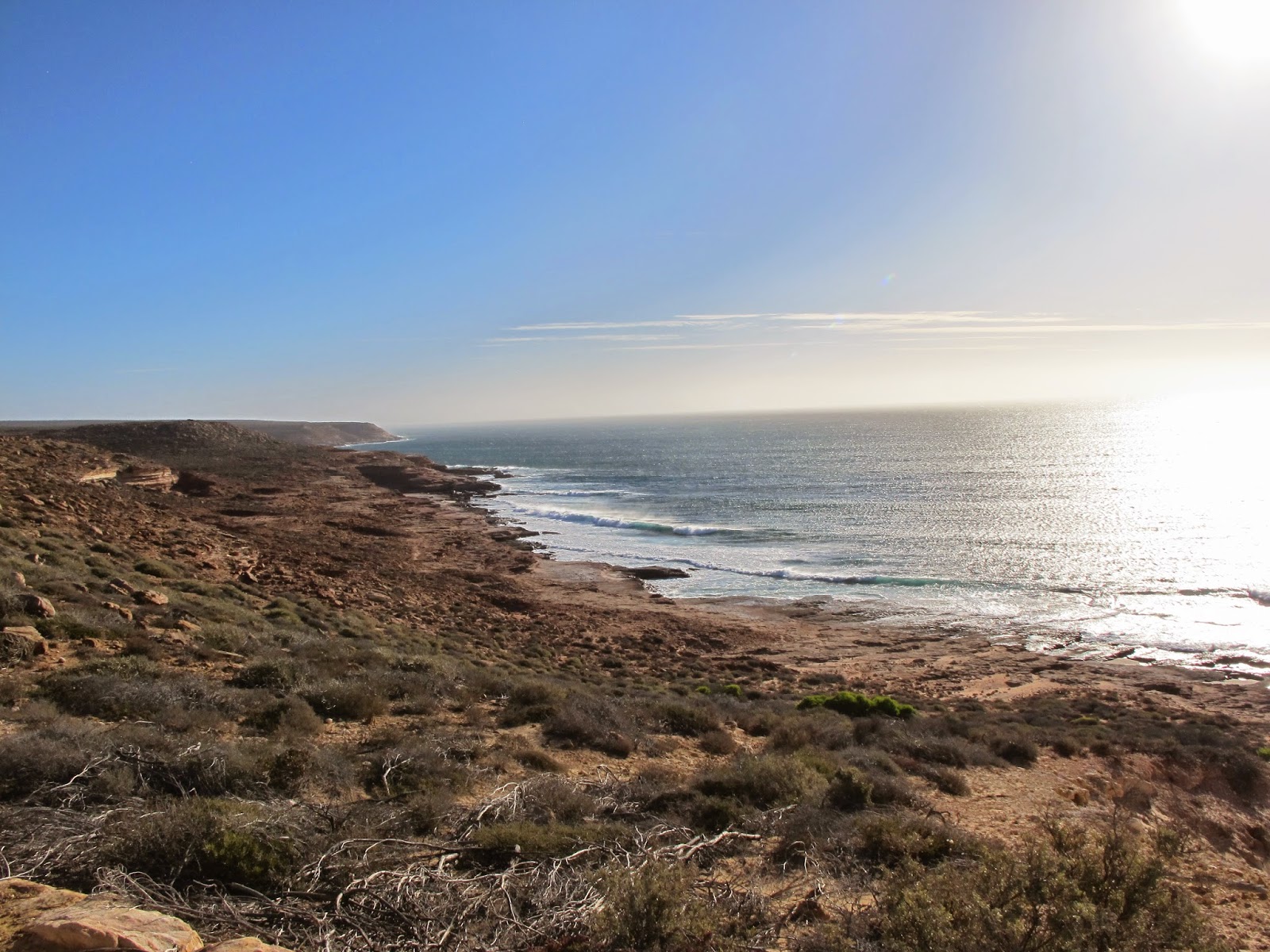
 After a much needed siesta, swim in the pool and dinner we decided it was time to see the coastline.  Just outside of Kalbarri are a significant number of lookouts, some require short walks and some you can drive right up to.  The wind was really howling but it didn't spoil the great views of the coastline and Indian Ocean.


The next morning we headed back up to Kalbarri National Park and this time went to the Z Bend trail.  This trail is about the same 500meters from the car park and this time there is a small amount of water to see...though not flowing.  We went earlier this time which meant the heat was more bearable.


After we got back to town it was time for another Siesta, swim and then we found some Pizza at Kalbarri Pizza and let the kids burn off some energy.


One of the real highlights for me in this sleepy little tourist town is where the Indian Ocean meets the Murchison River.  Not 500 meters away you have the strong surf of the Indian Ocean but the water in town is almost perfectly still and perfect for swimming.  That is not to mention a great spot to catch the sunset.


This was a really great mini vacation that I would highly recommend to anyone willing to make the trip up.


Sunday, May 4, 2014

Preparing for an Australian winter

When you've lived over 35 years in 2 of the coldest cities on the planet the idea of feeling cold in Perth seems mad.  Outdoors is never an issue...it never goes below zero celsius and most days will still reach a high in the teens.  That said, after 2 winters here and approaching a third I have never felt so cold inside a house as I have in Perth.

The majority of houses here are built with an extremely simple form of insulation: air.  Houses have two layers of brick with an air gap in between.  Unless the house was build in the last 5 or so years it will have no insulation in the attic.  Regardless of build date it will have single pane / glazed windows.  This makes for a structure that gets cold fast and stays cold without significant heat input.

Heat can be provided in a number of ways:  
1) Centrally via either natural gas (I've never actually seen a house with this but I'm told it exists) or reverse cycle air conditioning (electricity).  Vents tend only to be in major areas.  You don't see them in bathrooms, closets or laundry rooms typically.  Ducted reverse cycle is the most comfortable year round solution in Australia.


2) Split unit reverse cycle air conditioners (electrically run) which will only heat or cool in the room their in.  If sized properly these work well and make for one of the most energy efficient solutions as the idea is you only turn them on when needed.
 

3) A gas point is provided in multiple places in the house for you to connect a gas heater which can be purchased for 900 to 1200 dollars each new.  A note of caution, these units are self contained and have no mechanism to exhaust gases such as carbon monoxide.  Houses are never equipped with carbon monoxide sensors.  I'm told that state governments have run campaigns in the past to try to get people to get rid of their old dangerous gas heaters in exchange for newer safer ones.   It is suggested when running these units that you have windows or doors open a bit to ensure ventilation.  One could suggest that the less than modern aussie construction techniques leave houses so loose in terms of air movement that this isn't a real problem.


4) A wood burning stove (Jarrah hard wood seems to be the fuel of choice and number of companies offer bulk home delivery starting around $150 per 1/2 tonne).  The heat is uber nice but of course you have very little control and they are not exactly low maintenance.


5) Bathrooms often have heat lamps which feel nice and would keep a roast turkey warm in a pinch.

I should mention that thermostats are also very rudimentary when compared to North America.  Those used to smart thermostats that set the temperature based on when you're home or awake might be disappointed. By contrast, split units allow you to set the temperature of the air coming out, and have timers.  Central ducted units allow you to set the room temperature and have timers.  Many systems are purely on or off.

So that all said, this year we've got a combination of available heat.  One split unit in the master bedroom.  A wood stove in the living room.  A gas point in the same room, and a gas point in the main kitchen / living area.  Kids rooms have...well...blankets.

I've ordered 500 kg of jarrah which showed up next day.  A lot of it is little tiny pieces so I'm not sure how long it'll last but it's dry and it definitely burns.  The reverse cycle in the master works really well.  I'm thinking we may add a gas heater to the house as a last resort if we get to a point that we can't get the majority of the house above 17 C. 


Thursday, April 17, 2014

The australian public school vs private school dillema


I can't name a private school in Edmonton.  If we still lived there today Olivia would be in a public school and it's very likely that we would rave about it as we did the program she was in run by the Edmonton Catholic School board before we left.

Schooling in Australia is very different.  You have 4 (that I know of there might be more) types of schools.  Private, Catholic Private, Independant Public and Public schools.  Mention to the right person an intention of sending your kids to public school and you will get a gasp akin to the announcement that you have decided to have your children raised by wolves.

So my question became:  Is this reaction valid?  Are the public schools that bad?  Is it really necessary to spend 14 - 25K per child per year for private school?

Our first decision was made easier by the fact that the company that brought us to Perth would pay the cost of Private School.  Why take the risk?  We had a suspect discussion at a public school where we were living and were able to find a spot at the closest private school: Wesley College.  Wesley is an old boys school that have begun introducing girls.  A family one time initiation fee of around 6K plus 13K in annual dues would get Olivia into the kindy program (4-5 years of age). 

A mural displayed at Wesley College in South Perth
This year things are different.  We do not have the warm cotton blanket expat package to fall back on. Olivia would cost 14-15K and Owen would start pre-kindy at 7-9K.  Take into account the Australian taxes and I have to earn nearly 40K just for their private schooling and this number would rise quickly as they grow up.

And so after much debate (Angie is a teacher by profession), research, reading, discussion with other parents we decided to try public schools.  Two months ago Olivia started at a Independant public school in the area we're living in.

I plan to continue to update my observations on this little experiment but here are my initial observations:

Facilities:  The facilities at Wesley and many of the expensive private schools are over the top impressive.  They are in pristine condition, contantly being added to, well landscaped and remind me of small universities or Harry Potter's Hogwarts rather than children's schools.  The public school we have Olivia at has seen better days in terms of condition.  Maybe much better days.  That's not to say that it is a dump, it just has a need for maintenance in certain areas and is not nearly as grand.  

Private schools are marketing machines catering to parents emotions:  Every piece of literature, every communication at Wesley was "prettied up", had gone through a marketing agency, was printed on thick paper stock and drove the message that you were in an elite, storied place that created elite leaders of tomorrow.  You feel special there.  You get to say "My kids go to Wesley"  You rub elbows with other elite parents (doctors, lawyers, bank executives etc).  They send countless e-mails, massive newsletters printed like high end annual reports from forture 500 companies reinforcing the greatness that is the Wesley experience.

Private schools are never done asking for money:  You've paid nearly 20K for tuition, so you're done right?  Yeah, right!  Fund raising events at 50-100 bucks a head, emails asking for donations to keep the storied history alive, 400 / term for violin lessons, mandated uniforms double the price of public school uniforms the same quality.  It never stops.

Public schools are for students:  You will not get big fancy propoganda books.  I haven't been invited for a champagne charity event overlooking the city.  We have however already had an assessment of Olivia's reading skills and the areas the teacher will be focused on.  Want to send the teacher an e-mail.  You can but she only reads them once per week.  She'll be happy to talk to you when you come in though.  So far I see a focus on the accademics that I didn't see at Wesley.  (Keep in mind Olivia is very young.)

The base curriculum is the same:  I think this often gets lost.  Private schools like public schools are bound by Australian laws as to what they must teach.  They can add, but they can't subtract.  Private schools and independant schools appear to have some flexibility in how they present certain materials vs the pure public schools.  For example the pure public schools are still teaching the font, Victorian modern cursive which I'm not sure I had even seen before.  I'm sure as we get on there will be elements of the Aussie curriculum that will drive us crazy but nothing that we can't top up at home.

Teachers appear more strict at the public schools:  This is an observation shared by other friends of mine in discussion.  The private school would have us believe their more carefree approach is their method of driving leadership characteristics.  Time will tell....I think Olivia can use a little more authority as seen in her new school.

Either way, good teachers matter:  I liked Olivia's teacher at Wesley.  She was relatively new to teaching but had a gentle way about her and I think Olivia learned some life skills from her.  Her new public school teacher is clearly experienced and very strong.  Watching her assess students is quite impressive.  She is a no nosense, get the job done kind of person that I think we will reflect on fondly in years to come.    

We're two months in and only comparing one young student across two schools.  I'm going to continue to share my observations on this as we're talking about the two most prized things in Angie and my life: Olivia and Owen.    

My friend Alan said something that has stuck with me:  "No matter what school you put your child in, one thing remains true.  The bright ones always rise to the top."


Sunday, March 9, 2014

Taking back control - An Update


This is an update to the post Expat life can be a bleepedy bleep.  It can be read here: http://expatchapter.blogspot.com/2014/01/expat-life-can-be-bleepedy-bleep.html

Uncertainty with a family in tow is beyond stress.  In this case that uncertainty which began on the first of November had almost become paralysing.  In the span of 3+ months we were preparing for a move to Norway, pushed to move to the dirtiest city in the US (which was never going to happen), talking seriously about Oman, decided to move to Houston... and then not to move to Houston.

The one thing that was certain was on January 31, the lease on our company provided house would expire.  In early January I was told that jobs at my level were scarce due to current cost reviews and if I did not accept the dirty California city job and/or find something else, the family would be sent back to Canada and my employment terminated.  

Mid January, I was told the family would be moved into temporary accomodation and our things moved into storage.  At that point I felt the need to push back.  "Ummm no sorry, that's not going to happen.  Find me a job, tell me where we're going, then we will move.  Get a plan together."  Amazingly it bought some time.

In late January a decent offer for a 20 month role was made in Houston.  Ok...lets get our questions together and get them answered...looks like we're moving to Houston.  There are worse places in the world.  

Thoughts of what this new life would look like became impossible to suppress.  I'm going to move to Houston and sit in traffic.  The car will be nice but it will be parked on a freeway.  Days will go by where I come home after the kids are in bed.  Another 6 months of transition coming for the family, and then in 20 months we'll do this all over again.

Time to take control of the situation.

The questions about Houston would never really be answered.  I suppose a combination of expectation that I would just take what was offered and lovely HR people strangled by processes preventing them from doing what mattered.

"Show me the termination package.  Make it so we can stay in Perth.  We're not getting on an airplane."

After 3 weeks of back and forth I signed a termination package.  In the middle we were moved to temporary accommodation and had our stuff moved to storage.

Uncertainty OVER, time to act!

In 2 weeks we:
Found an awesome house North of the CBD at a reasonable rental.
Found a job with another US company in the middle of an aquisition integration in Perth
Had the visa transfered to new company
Bought a second car 
Got Olivia into a new school.
Moved into the new house.
Started to relax.

In all I would work for "The big red machine" for just under 9 years.  It's a company filled with talented wonderful people who I will miss dearly.  As much as this process made the company seem evil, it's hardly the case.  More-so a case of  bad timing and a few bad apples in the mix. 

Time to go back to enjoying life and putting the focus back to the family.

Owen at the new house